Monday, February 27, 2006


Interpreting new label rules

New FDA labeling requirements for trans-fat and allergens take effect this year. Learn what bakeries need to do to comply with the law.

January 1 marked a new year. For food retailers, it also was the dawn of new labeling requirements. The Food and Drug Administration’s (FDA) new trans-fat and allergen labeling requirements went into effect at midnight, Jan. 1. Nutrition labels now require the amount of trans-fat be broken out from the total fat amount. And, products must also state if they contain one or more of the eight common allergens.

The effect on bakeries varies. If bakeries sell packaged products and sell more than $500,000, they need to have some sort of ingredient label on those products. However, products that are placed in packaging in response to a customer’s order do not require any nutrition information or allergen listing.

Understanding the requirements ensures your products are labeled accurately, and allows you to use labeling to your advantage.

Trans-fat

The area of labeling receiving much attention is trans-fat with its many harmful effects. The impetus behind the attention is the official debut of trans-fat on nutrition labels in 2006.

Trans-fat is created when liquid oils are made into solid fat, a process called hydrogenation. A small amount of trans-fat occurs naturally, primarily in animal-based foods, such as dairy products. However, the primary source of trans-fat for bakers is shortening and margarine. These are staple ingredients for many sweetgoods.

Although the FDA brought trans-fat into spotlight, the administration is not suggesting people eliminate trans-fat completely from their diets. To do so would require consumers to make monumental shifts in eating habits. Bakers report that customer response to trans-fat initiatives has been low.More importantly for retail bakers, manufacturers producing ready-to-eat food on site are not required to have a nutritional fact panel. However, manufacturers that ship food to other locations must have nutrition facts labels on packaged products.

The nutrition facts label is the listing of serving size, calories, fat and other nutrients in the product. Under the new requirements, fat must now be listed with the total amount first, followed by the breakdowns of saturated fat and trans-fat. Sounds simple enough, but even this gets confusing.

Even if the product’s serving size contains no trans-fat, you must separate the fat and list the trans-fat as zero. However, if the serving contains 0.5 grams or less of trans-fat, the amount listed on the nutrition facts is zero, as long as no health claims are made. For example, if your cookie has 0.25 grams of trans-fat, you can list the amount as zero if your package does not contain a claim of low or no trans-fat.

If the product contains shortening or margarine, both sources of trans-fat that must be declared in the ingredient list, the product still can have the trans-fat listed as zero as long as the serving contains 0.5 grams or less.

If your product does not contain trans-fat, how can you let your customer know? That is still questionable. At present, the FDA has not established nutrient claims retailers can use regarding the amount of trans-fat.

While trans-fat is not being banned, the media attention on its harmful effects has prompted some food manufacturers to adjust their formulations to lower the amount of trans-fat in their products. Retail bakers, for the most part, say they are relying on their suppliers to provide trans-fat alternatives.

The reformulation will come from the suppliers changing the ingredients, not the bakers themselves making changes to their product.

Allergens

Jan. 1, 2006 also required that products must clearly state if they contain any of the eight major allergens. Accounting for more than 90 percent of all documented allergic reactions, the eight allergens are: milk, eggs, fish (bass, flounder, cod, etc.), crustacean shell fish (crab, lobster, shrimp, etc.), tree nuts (almonds, pecans, walnuts, etc.), peanuts, wheat and soybeans.

The FDA estimates that two percent of adults and five percent of infants and young children in the United States are allergic to some type of food. About 30,000 people require emergency room treatment, and 150 die each year because of allergic reactions to food.

To indicate the presence of an allergen, manufacturers have two options. One, they may list the allergen in the ingredient list. All packaged products must contain an ingredient list, if the manufacturer reports more than $500,00 in sales.

For example, if the product contains enriched flour, the components of enriched flour, such as wheat flour, must be listed in parentheses after the ingredient. For ingredients that have several names, the most common name must be listed in parentheses. For example, whey (milk), or lecithin (soy).

The second option is to use the word “contains” followed by the name of the ingredient that is the major allergen. For example: Contains wheat, milk and soy. This statement must be immediately after or adjacent to the ingredient list and in a type size that is no smaller than that used for the ingredient list.

Bakers have long been aware of the dangers of food allergies, and even though there are no requirements to do so, many have already taken steps to let customers know the dangers people with food allergies may face when consuming bakery products.

Requirements may not apply to all bakeries, but knowing the rules are important as your bakery grows and you need to answer customers’ questions. Labeling also works as a marketing and promotional tool. Let your labels tell customers what they need to know.

Health claims and whole grains

Along with the FDA’s changes in labeling requirements, the USDA recently revised the U.S. Dietary Guidelines. The new recommendations suggest that at least half of Americans’ daily grain servings should come from whole grain foods, a minimum of three 1-oz. servings a day. This has raised consumer interest in whole grains.

To help bakers educate consumers about the amount of whole grains in their products, the Whole Grains Council created the Whole Grain Stamp.The stamp allows producers to designate their products as a good source of whole grains, excellent source of whole grains and 100 percent whole wheat.

Making sense of nutrition labels

While nutrition listings have changed, the standard label format has not. A nutrition facts panel, the breakdown of serving size, calories and fat, is required for all packaged products sold off site if bakery sales are more than $500,000 annually. A nutrition facts panel also is required if a health claim, such as low fat or sugar-free, is made on the package.

For packaged products, the part of the package that customers are likely to see first must feature the primary display label (PDP). It also should contain the net quantity or amount of the product.

The information panel needs to be positioned to the right of the PDP. The information panel should include the ingredient list, allergens, and the nutrition facts, if required.

The ingredient list should be in descending order by weight. Water is considered an ingredient. Enhanced ingredients must list their own ingredients in parenthesis. For example, if you use milk chocolate it must be listed as: milk chocolate (sugar, cocoa butter, unsweetened chocolate, whole milk powder, soy lecithin, vanilla). All spices must be listed separately, and if you use artificial colors or flavors, you must declare which ones. Finally, you must list all the allergens the product contains.The information panel also should include the company name, city, state and zip code. If your company is not listed in the phone directory, you must also include the street address. You may include phone and fax numbers and a web address.

For bakeries whose products must include a nutrition facts label, the label required depends on the amount of space on the package. If your label space is under 12 sq. ins., you must provide a phone number for customers to call for nutrition information. If the label is between 12 and 40 sq. ins., you can use the tabular or the linear forms. For labels over 40 sq. ins., you must use the long tabular form, which includes diet recommendations.

Sunday, February 19, 2006

Restaurants feel pressure to go high-tech

Before long, you'll probably be able to browse a restaurant's menu, order your dinner and pay the check through your cellular telephone. One day, diners may be able to assess a restaurant's wine selection through a tablet PC at each table.

For restaurant owners who have already adopted similar technology, they've found it a powerful way to boost profits, increase efficiency, refine menus — and hopefully please customers. Some are reporting 30 percent savings in wait staff payroll, 20 percent increases in service speed and notable decline in frustration.

Systems that simply track sales and handle finances have been available for years, but a growing level of high-tech sophistication is bringing restaurants the chance to electronically monitor customer preferences, orchestrate the cooking process second by second, and even digitally monitor how much booze a bartender is pouring.

"Everybody needs an edge over their competitors at this point," said Bill Fultz, operations manager for Delaware Business Systems, a New Castle, Del., seller of restaurant technology systems.

It solved one headache for Scott Godfrey, owner of Premium's Original Sub and Steak Delicatessen.

"We were losing anywhere from $20 to $50 a day with the old cash register" because of suspected employee theft at the Milltown, Del., eatery, he said. The solution was a system that requires orders to go through the register before being sent to a display in the kitchen, along with biometric equipment that requires employees to log on with a thumbprint.

Such systems are not cheap, especially for a recent startup — Godfrey paid $11,000. But Godfrey has been convinced it will pay for itself. Switching to the tech solution seems a wise move now, he said, but came first with its complications.

"The first week was sort of like Pearl Harbor," he said. "You didn't know what direction you were running."

Once the staff mastered the system, Godfrey said, it allowed the business to cut errors in customer orders and appraise menu items' popularity.

In time, more restaurants will use computers to tailor menus and other features more closely to customers' preferences, said Frederick J. DeMicco, professor at the University of Delaware's College of Hotel, Restaurant and Institutional Management. The latest products can estimate how long it will take a party to finish a meal, producing more accurate wait times for hosts.
For now, though, some restaurants aren't using the technology to its fullest potential, according to a recent study by Hospitality Technology magazine. Most recognize its advantages in productivity, efficiency and costs, but lag in bringing technology solutions to the kitchen and other areas — only 4 percent use customer data for analyzing trends, and 2 percent for marketing.

A diner's capacity to appraise and review restaurants online has "leveled the playing field for all," and will increasingly compel restaurants to respond to those higher expectations with their own technological solutions, DeMicco said. In time, customers will come to expect more, he added.

"Guests are demanding the technology — for example, Wi-Fi, online ordering, easy-to-navigate Web sites for reservations, booking, ordering," he said. "For companies, they have to use technology to drive their profit strategy, to customize the guest experience."

Wednesday, February 01, 2006


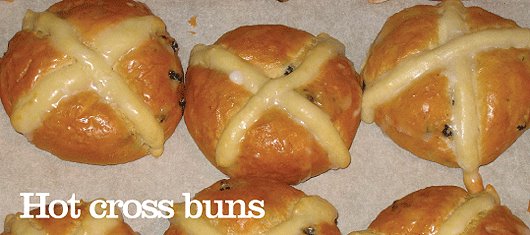
Hot Cross Buns

The season is coming for this traditional product

makes 24

1 cup milk
2 Tbsp yeast
1/2 cup sugar
2 tsp. salt
1/3 cup butter, melted and cooled
1 1/2 tsp. cinnamon
1/2 tsp. nutmeg
4 eggs
5 cup flour1
1/3 cup currants or raisins
1 egg white

Glaze

(you can use this one or your favorite)1 1/3 cup confectioner's sugar 1 1/2 tsp. finely chopped lemon zest 1/2 tsp. lemon extract1-2 Tbsp milk

In a small saucepan, heat milk to very warm, but not hot (110°F if using a candy thermometer). Pour warm milk in a bowl and sprinkle yeast over. Mix to dissolve and let sit for 5 minutes.

Stirring constantly, add sugar, salt, butter, cinnamon, nutmeg and eggs. Gradually mix in flour, dough will be wet and sticky. Continue kneading until smooth, about 5 minutes. Cover bowl with plastic wrap and let the dough "rest" for 30-45 minutes.

Knead again until smooth and elastic, for about 3 more minutes. Add currants or raisins and knead until well mixed. At this point, dough will still be fairly wet and sticky. Shape dough in a ball, place in a buttered dish, cover with plastic wrap and let rise overnight in the refrigerator. Excess moisture will be absorbed by the morning.

Let dough sit at room temperature for about a half-hour. Line a large baking pan (or pans) with parchment paper (you could also lightly grease a baking pan, but parchment works better). Divide dough into 24 equal pieces (in half, half again, etc., etc.). Shape each portion into a ball and place on baking sheet, about 1/2 inch apart. Cover with a clean kitchen towel and let rise in a warm, draft-free place until doubled in size, about 1 1/2 hours.

In the meantime, pre-heat oven to 400° F. When buns have risen, take a sharp or serrated knife and carefully slash buns with a cross. Brush them with egg white and place in oven. Bake for 10 minutes, then reduce heat to 350° F, then bake until golden brown, about 15 minutes more. Transfer to a wire rack. Whisk together glaze ingredients, and spoon over buns in a cross pattern. Serve warm, if possible.

History of the Hot Cross Bun:

Hot cross buns are typically eaten on Good Friday and during Lent

Stories abound about the origins of the Hot Cross Bun. Yet, the common thread throughout is the symbolism of the "cross" of icing which adorns the bun itself.

Some say that the origin of Hot Cross Buns dates back to the 12th century, when an Angelican monk was said to have placed the sign of the cross on the buns, to honor Good Friday, a Christian holiday also known as the Day of the Cross.

Supposedly, this pastry was the only thing permitted to enter the mouths of the faithful on this holy day. Other accounts talk of an English widow, who's son went off to sea. She vowed to bake him a bun every Good Friday. When he didn't return she continued to bake a hotcross bun for him each year and hung it in the bakery window in good faith that he would some day return to her. The English people kept the tradition for her even after she passed away.

Others say that Hot Cross Buns have pagan roots as part of spring festivals and that the monks simply added the cross to convert people to Christians. Even if this is the case, I think it was rather bright of the monks to be able to so readily tie existing traditions to Christianity!

Monday, January 30, 2006


Coffee and bakery form natural synergy

As Americans continue to feed their java fix, bakery operators are brewing new sales opportunities.

How much do Americans crave coffee? If a recent survey by Dunkin’ Donuts is any indication, they would rather give up sex (25 percent) than their daily cup of java (19 percent). America’s infatuation with the bean isn’t surprising news to Dunkin’ or to a number of other bakery product retailers across the country.

According to the Specialty Coffee Association of America (SCAA), about 56 percent of American adults consume specialty coffee on a daily basis. The Long Beach, Calif.-based trade organization defines specialty as “coffee that has no defects and has distinctive flavor in the cup.” Only 9 percent consumed specialty coffee daily in 1999. The bottom line in terms of daily consumption is a grand total of more than 300 million cups of coffee a day.

But it’s not just the big guys who benefit from consumers’ bond with the brew. Tom Ivory, owner of Baker Street Bread Co., an artisan bakery in the Chestnut Hill suburb of Philadelphia, reports coffee sales of about $50,000 from a 15-sq.-ft., self-serve station. Even more, he estimates that he sells an additional $50,000 worth of bakery products to those coffee drinkers.

Coffee and bakery routine

“Many customers establish a daily routine of stopping in for their cup of coffee, some more than once a day,” Ivory explains. “And when they come in to get their coffee, they usually end up buying a muffin, cookie or loaf of bread.”

Even with a Starbuck’s right across the street, Dinkel’s Bakery in Chicago has not felt the need to expand into espresso or take the leap into lattes. In fact, says Eric Dinkel, manager of the more than 40-year-old bakery that has consistently maintained a modest menu of regular, French roast, decaf and one flavored selection per day, the java juggernaut has not had much of an impact on his operation’s coffee sales since it moved in about 10 years ago.

“The other day my dad (third-generation owner Norm Dinkel) was saying that my grandfather would have thought it was crazy for a bakery to sell coffee,” Eric notes. “Now customers who come in to buy a donut expect to be able to buy a cup of coffee to go with it.

”Kate LaPoint, owner of To The Point Business Imaging, a Seattle-based firm specializing in marketing and public relations for the specialty coffee industry says that customers expect the coffee they purchase at bakeries to be on par with the quality of the other products available there.

“Customers are much happier when they can find the best cup of coffee at the same place where they can find the best donut, muffin or pastry,” LaPoint says. “And the quality of the one category of products reinforces the perception of quality of the other.

”While coffee isn’t the biggest seller on the menu at Bear Rock CafĂ©, it has definitely played a big part in establishing the upscale image of the 38-unit restaurant chain, says Deneen Nethercutt, vice president of marketing for the Cary, N.C.-based company.

“It is also a great source of incremental sales without requiring any additional labor,” Nethercutt notes.

In addition to four different blends of drip coffee, which are brewed fresh hourly, Bear Rock offers a full line of espresso and cappuccino drinks. Most popular is the Bear Latte, a signature sipper made with espresso, steamed milk, honey, vanilla, spice and a crown of whipped cream.

Coffee also perks up pastry sales during off-peak late morning, afternoon and evening day-parts at Bear Rock, Nethercutt says. The company is currently working on a line of iced specialty coffee beverages for introduction in the spring.

To satisfy his customers’ cravings for espresso-based drinks, Raul Porto, owner of Porto’s Bakery in Glendale, Calif., added them to his regular coffee menu about seven years ago. But it wasn’t until he moved his brews from a station in the corner to a dedicated coffee bar with expanded seating, its own signage and trained hat-and-scarf-clad baristas that his beverage sales doubled and bakery products began to move at an accelerated rate.

Hired a beverage manager

Based on this success, Porto is putting coffee “center stage” at his newly opened second location in Glendale. He also hired a beverage manager specifically to handle the coffee operations at both stores.

Rick Boone, owner of Rick’s Bakery in Fayetteville, Ark., also discovered the importance of proper positioning when he invested somewhere between $35,000 and $40,000 into a 12-sq.-ft. coffee bar. Customers loved the coffee, he says, but didn’t like waiting on one side of the L-shaped building for their barista-made beverages, then having to wait in a second line across the store for their bakery products.

Combining the two components didn’t help much either as core pastry and donut sales were slowed up as employees tried to juggle the jobs of making espresso drinks with filling bakery product orders. Changing to a centrally-located self-serve air pot system has solved Boone’s problem and boosted coffee sales. However, he’s still not ready to totally abandon the idea of baristas.

“I really feel that there’s a place for barista-made coffee drinks in this bakery; we just have to work at becoming more efficient to make it work,” he says.

Offering flavor shots

For Dunkin’, flavor customization is the next frontier. Last spring, the company launched “Flavorology,” a new program that allows customers to mix and match up to three of nine sugar-free “flavor shots” (options range from caramel to blueberry to marshmallow) to create their own signature hot or iced beverages. The result of two years of testing, flavor shots make it possible for the company to offer more coffee and hot chocolate variations without having to brew or hold a separate pot of coffee for each one.

“Because we only have to brew two types of coffee–regular and decaf–we have less waste even though we’re offering more flavors,” says Dunkin’s Ellen Rogers, manager of coffee excellence.

When it comes to coffee, today’s consumers are thirsty for quantity as well as quality. At Rick’s Bakery, Boone says that a growing number of customers are requesting coffee in one-, three- and five-gallon containers. To accommodate these volume orders without slowing down by-the-cup sales, the bakery is adding a six-gallon quick-brew station.

Last year, Dinkel’s also added a 10-cup cardboard container with a thermal plastic pouch to its coffee options for customers who want to tote the bakery’s brew to office meetings. Ivory is considering adding a 20-oz. cup for serious aficionados.

Maintaining maximum freshness throughout the day is probably the biggest challenge for bakeries with coffee service, Dinkel says. To make sure every customer gets a hot, fresh cup, the bakery downsized from a large 30-cup container with spigots to small air pots that can be refilled more frequently with minimal waste.

“The only downside I can see with coffee service is not doing it,” Porto says. “I wish the rest of our business was that easy.”