Bakeries tackle food allergy concerns
Consumers with special dietary needs are becoming the norm rather than the exception. Learn how bakers are developing business with ‘free-from’ products.
“Food allergies” are more than a marketing buzz phrase. They are the future. Americans’ ever-expanding waistlines, heredity, the environment and increased diagnosis of food-related medical conditions, like diabetes and celiac disease (a potentially life-threatening intolerance to gluten), has increased customer awareness of ingredients. As a result, demand for “free-from” products (e.g., gluten-free, dairy-free, sugar-free, etc.), especially baked goods, has begun to swell.
Unlike fads, such as low carb, these are diagnosed or suspected medical conditions that are managed, along with medication in some cases, by controlling intake of specific ingredients.
While few traditional bakeries have embraced the special dietary needs or allergen-free products markets, the specialized bakeries that have are doing well, in terms of strong sales growth and grateful expressions of joy from their customers. Based on the population data, sales performance and the growing adoption of these products by major supermarket chains, these specialty markets are getting closer to becoming mainstream every day.
Or, as Rebecca Reilly, author of Gluten-Free Baking, explained to the New York Times (December 14, 2005), “When you’re told you can’t have something, then it becomes the focus. It’s like the forbidden fruit.’’
That’s why gluten-free, sugar-free, and, for the food sensitive, kosher bakery products are finding leverage among today’s consumers.
Food allergies
About one in 25 Americans suffers from a true food allergy–meaning that ingestion of substances, such as nuts, gluten and lactose, always causes an allergic reaction, according to medical sources cited in the Food Allergies and Intolerances-U.S. report by Mintel International Group of Chicago. In addition, slightly more than one in four Americans are said to suffer from food intolerance, a non-life-threatening condition in which the body is unable to produce enough of the natural digestive chemicals to break down a particular type of food. However, despite the statistics, according to Mintel, one in three believe that they are affected by food ingredients in some way.
In addition, studies conducted during the past five years have shown that the incidence of food allergies are quickly increasing, particularly among children.
Growth market
One of the most common illnesses caused by food is celiac disease. It is not known why, but cases of celiac disease are on the rise. While the condition may be detected at any age, the average age of diagnosis is 44 years. The only treatment for celiac disease is a lifelong avoidance of gluten-based products. Statistics vary, but The University of Maryland Center for Celiac Research in Baltimore found that one in 133 individuals (about 2.2 million Americans) suffer from it, including many who are never tested and fail to make the connection between intense stomach pain and eating gluten. Symptoms of celiac disease include anemia, malnutrition, osteoporosis, central and peripheral nervous system disorders, intestinal lymphomas and other food sensitivities.
“As the awareness and the diagnosis rates for people with food allergies and food intolerances continues to grow, and there’s more press about this, the market is just starting to explode,” says Scott Mandell, president/C.E.O. of Chicago-based Enjoy Life Natural Brands.
Mandell co-founded Enjoy Life, a wholesale bakery specializing in gluten-free products, with partner Bert Cohen several years ago. They were inspired by Cohen’s mother’s medical need for specialized foods. With traditional supermarket chains throughout the country carrying Enjoy Life products, such as Shaw’s, Giant Eagle and Jewel, to name a few, Mandell believes the market is heading mainstream.
“There’s no question about it,” he continues. “The larger grocery store chains see this as a real market. It’s not a fad. It’s not low carb. It’s something that’s here and will be here to stay. People need it for medical reasons.
“The number we’ve seen in the industry is about 25 percent growth annually for food allergy and intolerance products. Our company has seen triple digit annual growth,” he adds.
Trust factor
Because these baked products address health and allergy issues, with potentially severe consequences, Mandell and others say that much diligence is required when producing products for this market.
“You don’t want to take the risk of getting somebody sick. So you have to take extra special precautions if you’re getting into this market,” Mandel says.
Even though there are no formal gluten-free standards (the FDA won’t have them until 2008, at least), Enjoy Life has set its own allergen standard at 10 parts per million for gluten, dairy and nuts. And, it tests regularly. As a result, the company has become the first bakery in the nation to be certified by the Gluten-Free Certification Organization.
“We’re hardcore,” Mandell admits. “It’s what our customers expect from us. It’s a trust factor.”
Due diligence
“We have to be really diligent,” says Cameo LeBrun, president of Crave, a San Francisco-based wheat-, gluten- and milk-free bakery. In addition to practical paranoia about cross-contamination, she has to research and source ingredients more stringently than traditional bakeries, asking her suppliers a lot of hard questions most people don’t have to ask, such as:
• Where does this product come from?
• Does that facility have wheat?
• Do you truck your ingredients with wheat products?
• What do you do to cut down on cross-contamination?
LeBrun, who is gluten intolerant, was both discouraged and inspired by what was available: dry, tasteless product with bad texture. She opened her wholesale bakery 2-1/2 years ago and sells to Whole Foods and local high-end grocery stores: Andronico’s, Draeger’s, Harvest, Real Food Company and other specialty stores. In response to the growing product demand, she says her bakery’s chocolate usage more than doubled in 2005 to 12,100 lbs., from 5,200 lbs. in 2004. Crave uses the chocolate primarily in its signature brownies.
Baking fundamentals apply
Taste still rules for dietary-needs bakers. After “free-from,” the next most important consideration is taste and texture. The product should appeal to everyone, regardless of their health needs.
Lareen Narva, owner of Bittersweet Gluten Free Bakery in Eagan, Minn., has had a wheat allergy for more than 20 years. Her entire family (husband and three children) is allergic to wheat too. She opened the bakery two years ago, and she’s already looking at expansion.
Frequently her customers are people who have eaten regular foods all their lives and have recently had to become gluten free. “People are sick and tired of bad-tasting gluten-free food. It’s been too many years of putting up with what the existing industry had,” she says.
As a result, she says the first question people ask is, “Does it taste real?” Then they ask, “Does it taste good?
”Her products must meet three criteria before she will sell them. 1) It has to look like the product you’re selling. “So it can’t be an icky-looking cookie or a shriveled up this or that,” she says. 2) It has to have moisture. “Because most gluten-free food is dry and grainy.” 3) It needs to taste like the name. “If it says chocolate cherry, it has to taste like chocolate cherry.
” Narva holds strictly to her three criteria when researching and developing product formulas. She says she spent15 years “playing around” with recipes before she finally came up with successful gluten-free baking techniques.
Kosher’s new demand
With the evolution of dietary needs products, another traditional approach, kosher (which is the Hebrew word for fit or proper as it relates to biblical dietary law), is being seen in a new light. Because kosher law forbids meat and milk together, a dairy-free bakery, among other things that are important to people with dietary concerns, can be a kosher bakery.
As Scott Mandell explains, “First, people who looked for kosher products did it mainly for religious reasons. Now, it’s become more of a standard for products being produced in a cleaner, safer environment. A lot of people look for that kosher symbol to give them that reassurance that, again, these products are produced under certain guidelines that are set out.
”Enjoy Life has been kosher since its inception. In order to be kosher certified, Mandell says all of your suppliers need to be kosher certified. Inspecting rabbis visit the bakery to check through all of your ingredients and make sure that everything that you’re getting is kosher.
Bakery equipment also needs to be inspected for kosher certification as well. He estimates that the process of having a bakery certified kosher takes three to six months.
One world
While the inspiration for their products is special dietary needs, bakers agree that the real secret to success in this niche is making products that appeal to everyone, special needs or not. Lareen Narva reports hearing customers complain that, “the gluten-free baked goods taste so good their non-allergic spouses are eating them all up.”
“And that’s our goal. Everybody should be able to enjoy this. It shouldn’t just be for celiacs,” Narva says. “In the big picture, celiacs shouldn’t have to compromise [about] food [quality] because they have this condition.”
Dietary Needs Facts
Obesity
• 40% of the population, 68 million, will be obese by 2010 if Americans continue to gain weight at the current rate.
• Since the 1980s, the proportion of overweight children has steadily increased.
Sources: Centers for Disease Control and Prevention (CDC), National Institute of Children’s Health and Human Development
Allergens
• 2% of adults and 5% of infants and young children in the United States are allergic to some type of food.
• Eight major food allergens account for more than 90 percent of all documented food allergies. They are: milk, eggs, fish, crustacean shellfish, tree nuts, peanuts, wheat and soybeans
• As of January 1, 2006, food manufacturers are required to list the eight major food allergens on their ingredient labels.
Source: FDA’s Food Allergen Labeling and Consumer Protection Act
Gluten
• 2004 retail sales of gluten-free products: $450 million, with projected annual growth of 34% from 2004 to 2006, with projected retail sales of $600 million.
• U.S. sales of gluten-free products have grown steadily by 17% per year since 1999.
• U.S. market for food allergy and intolerance products has nearly doubled since 1999, growing from $947 million in retail sales to more than $1.8 billion in 2003.
• Gluten-free market sales are projected to reach nearly $4 billion by 2008.
Sources: Mintel and “The U.S. Market for Food Allergy and Food Intolerance Products,” published by Packaged Facts, New York City
Diabetes
• 18.2 million Americans, or 6.3% of the U.S. population, have some form of diabetes.
• The more common Type II diabetes, most closely associated with old age, obesity, and other risk factors, can often be controlled without invasive medical attention.
• Diabetes is growing dramatically among blacks and Hispanics, the two largest minority groups in the U.S. The incidence of Type II diabetes among Hispanics, for example, is almost twice as high as that of the general population.
• The incidence of Type II diabetes among children and adolescents is also on the rise.
Source: American Diabetes Association (ADA)
Tuesday, June 13, 2006


Friday, May 26, 2006
Battle over saturated fat begins
It was just a matter of time before the Center for Science in the Public Interest (CSPI) waged a public battle against rising saturated fat levels in bakery foods that promote their absences of trans fats. From newspaper headlines to nightly newscast stories, saturated fats and their unhealthful properties once again dominate headlines.
CSPI submitted a letter to Food and Drug Administration (FDA) urging the agency to halt trans-fat claims on products that contain high levels of saturated fat.
"Some manufacturers misleadingly publicize the absence of trans fat to convince consumers that the manufacturers' products are healthful," CSPI's letter to FDA states. "However, '0 grams trans fat' claims on products that contain excessive amounts of saturated fat mislead consumers by implying that the food does not raise serum cholesterol levels or the risk of heart disease."
Casting the baking industry in the spotlight, CSPI's letter singled out two specific bakery foods as misleading consumers:
* Mrs. Smith's Apple Pie: This product features a red banner that claims "0 grams trans fat per serving," but contains 7 grams of saturated fat per serving.
* Sara Lee Pumpkin Pie: This product also claims 0 grams of trans fats, but contains 4 grams of saturated fat.
"Just because a food doesn't have trans fat, doesn't by itself make it a health food," says Michael Jacobson, CSPI's executive director. "Companies shouldn't foster confusion by making trans-fat claims on foods high in saturated fat, and FDA shouldn't let them get away with it."
CSPI urged FDA to establish a rule that mimics an existing rule prohibiting food companies from making "saturated fat free" claims on foods that have trans fats. CSPI says the agency should have a corresponding rule prohibiting "0 grams trans" claims on foods high in saturated fat. The daily value for saturated fat is 20 grams, making products with 4 grams or more saturated fat per serving "high" sources of saturated fats.
Thursday, May 11, 2006

Newly popular flour white AND healthy
Food processors are selling more of a newly popular flour that merges whole-wheat health benefits with the color, taste and texture of white bread.
The secret: white wheat, a grain that can be milled to resemble pancake-friendly all-purpose flour but is as healthy as traditional whole wheat.
Though white wheat has been available for years, it's recently garnered serious attention thanks to new government dietary guidelines urging Americans to eat at least three servings a day of whole grains.
Wednesday, May 03, 2006
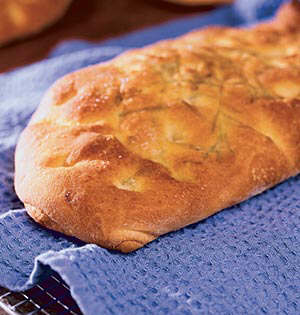
Focaccia with an Inlay of Pressed Herbs
This is a great recipe and can be expanded to be used in restaurants and bakeries
It's easy to double this recipe if you want to make more than one loaf. The bake is quick, so you can let the second loaf sit and wait its turn while the first is in the oven. This flatbread can be split and used for sandwiches or enjoyed on its own.
Yields one 10 x 6-inch flatbread.
5-1/3 oz. (1 cup plus 3 Tbs.) unbleached all-purpose flour
5-1/3 oz. (1 cup plus 3 Tbs.) durum flour, also called extra-fancy pasta flour
1/4 tsp. instant yeast (such as Red Star's QuickRise, Fleischmann's Bread Machine Yeast or Rapid Rise, or Saf Instant)
1 cup lukewarm water1 Tbs. extra-virgin olive oil; more for topping the loaf
1 tsp. saltA mix of herb leaves, such as rosemary, thyme, sage, flat-leaf parsley, summer savory, oregano, and chives
(about 1 cup, loosely packed)Coarse salt
Combine the flours and yeast in a large bowl. Add the water and oil; mix with your fingers just until combined smoothly. The dough will be wet and sticky. Cover the bowl with plastic and let rest for 15 to 20 minutes. After this rest (called an autolyse), mix in the salt.
Knead on an unfloured work surface. To knead, squeeze the dough vigorously between the thumbs and index fingers of both hands. Move along the length of the dough, squeezing hard enough to make holes where your thumbs and fingers meet. The dough will be sticky, but don't add flour -- use a dough scraper instead. Flip and repeat, squeezing along its length. Continue squeezing and flipping for 5 to 10 more minutes. Ideally the dough will come together and feel smooth, but if it's still sticky, don't worry -- the texture will improve during fermentation. Transfer to an unoiled bowl and cover with plastic.
After 30 minutes, lightly flour the dough's top and the work surface and then turn the dough out of the bowl. Gently spread the dough to flatten it but not to completely deflate it. Fold the dough into a tight square package, folding top down, side over, bottom up, and side over as you'd fold a handkerchief. Return it to the rising bowl, covered with plastic, for 30 minutes. Repeat this flattening, flouring, and folding. Let the dough ferment for 2 to 3 more hours, until doubled in volume and full of large bubbles. It should spring back when you press it.
Pull the dough out of the bowl, flour it well, and tuck the edges in to make a smooth package. Don't pop the bubbles, but do tighten. Flour, cover with plastic, and let rest for 10 to 15 minutes.
Flour your hands before shaping the dough. Press it into a 10x6-inch rectangle that's about 1 inch thick. Flour the dough again.
With floured hands, gently press and stretch the dough into a 10x6-inch rectangle that's a scant inch thick. Transfer to a sheet of floured parchment. Flour the dough again.
With a slender, floured rolling pin, roll out one-quarter of the long side of the dough, making a thin flap to cover the thicker, unrolled portion of the dough when folded over. Press with the rolling pin where the thin sheet joins the dough to make a sharp demarcation. If needed, use more flour to keep the dough from sticking. Moisten the thick half of the dough with water. Dip the herb leaves in water (shake off excess droplets) and arrange them on the thick portion of the dough. It's okay to crowd the leaves a little (they'll spread a bit after rolling), but don't overlap them. Fold over the thin sheet of dough to cover the herb leaves completely. Tuck the edges under and pat gently to push out any air bubbles. Starting from the short end, roll lightly with a floured rolling pin until the herbs come into sharp relief but have not popped through and the trapped air is expelled. Be gentle during rolling, even though you'll end up deflating the dough, and aim for an even shape.
Sprinkle flour on the dough and cover with plastic. Let proof until thicker and puffy, about 2 hours. To test, press the dough: the indentation should fill in slowly. An hour before the end of the proof, put a baking stone in the top third of the oven; heat the oven to 450°F.
When the dough is ready for the oven, brush off the flour and smear a thin layer of olive oil over the surface.
When the dough is fully proofed, brush off the flour with a dry pastry brush and then smear with a thin layer of olive oil (about 1 tablespoon). Dimple the loaf all over with your fingers, poking in between the herb leaves, pushing down to the bottom of the dough without breaking through. Sprinkle with coarse salt. Transfer the parchment and dough to the hot baking stone. Bake the dough on the parchment until deep golden all over, about 15 minutes, rotating after 10 minutes. The parchment will darken in the oven, but it won't catch fire. Transfer the bread to a rack and enjoy soon: it's best still warm.
Subscribe to:
Posts (Atom)


 Posts

